
Service Documents
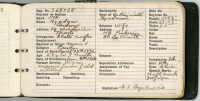
Platoon No. 8 Soldier Information Forms
This booklet of personal information forms was kept by Roy Parker, an officer with the 11th Battalion, Canadian Engineers, during the First World War. Such books allowed platoon leaders to keep track of the soldiers under their command.

General Orders 1916
The General Orders pamphlets were issued by the Minister of Militia and Defence in Militia Council, to be referenced by members of the Canadian Militia. The purpose of these pamphlets is to inform soldiers of essential instructions, procedures, and regulations.
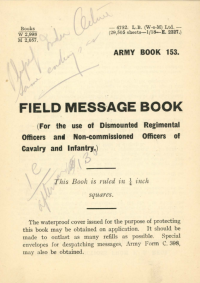
Field Message Book
Field message books are a type of notepad used by military officers while in the field so they can communicate within and between units. This book contains quite a few rules for the messages to ensure standardization and full comprehension from both the sender and recipient.
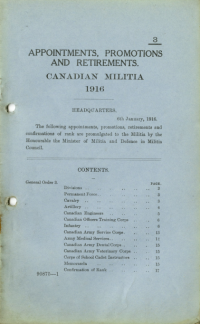
Appointments, Promotions, and Retirements
These booklets were issued by the Minister of Militia and Defense in Militia Council for the Canadian Militia. The purpose of these booklets were to document the members within each rank, their regiment, and any changes to rank/position.
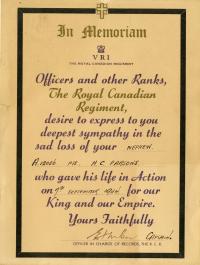
In Memoriam of a brave private
Pte. H. C. Parsons lost his life in action on September 7th, 1944. In recognition of his sacrifice and bravery, the men and officers of The Royal Canadian Regiment sent their sympathies to his family.
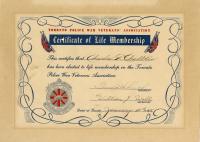
Toronto Police War Veteran's Association Certificate of Life Membership
During the First and Second World War many police officers left their posts to serve in the Canadian armed forces fighting overseas. Once they returned to Canada many were able to rejoin police departments all around the country. The Toronto Police War Veteran's Association was one of the largest of its kind, bringing together police officers who had at one point served in the Canadian army. This lifetime membership as presented to a war veteran in January of 1945.
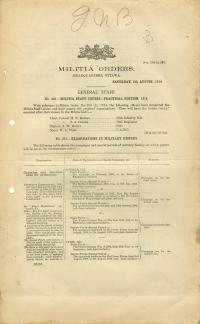
Militia Orders 1914
Promulgated in Ottawa, the Militia Orders covered a wide range of subjects, including appointments and postings, stores and clothing, certificates gained by militia officers, administrative staffs, and cadet services.
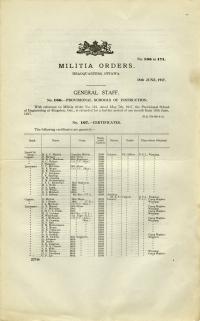
Militia Orders 1917
Promulgated in Ottawa, the Militia Orders covered a wide range of subjects, including appointments and postings, stores and clothing, certificates gained by militia officers, administrative staffs, and cadet services.
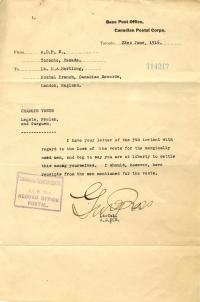
Lost in the mail
Everything had to be accounted for in wartime - even chamois vests bought by Canadian soldiers that were lost in transit.
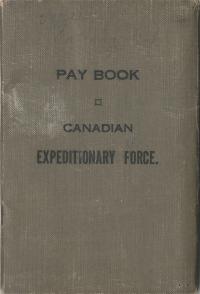
A soldier's paybook
Harry Catling, a thirteen-year veteran of the British Army, left Canada for England as a reservist as soon as the First World War began, returned to Canada when his term of service expired in 1916, and promptly enlisted in the Canadian Army Service Corps in Toronto.