
Air Raid Precautions
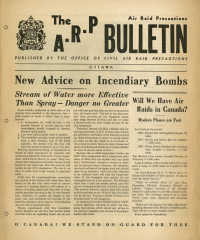
The A.R.P. Bulletin
The A.R.P Bulletin was published by the Office of Civil Air Raid Precautions as a short newspaper that covered regional and war-related topics.
ARP: Air Raid Precautions for Industrial and Business Premises
This training manual was published by the Air Raid Precautions (ARP) Organization to protect Canadian industrial facilities and their workers. This manual refers to a real-life air raid (the "Amazing Summer" in Britain, 1940) in order to teach individuals what to expect, and what to do, in the event of an enemy attack.
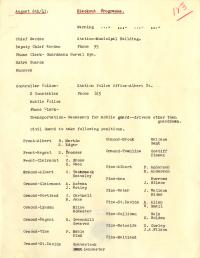
Preparing for aerial attack
The response to an air raid on Thorold, Ontario, was planned with military precision, but the plans never had to be put into action.
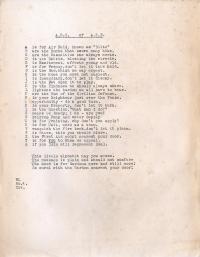
"I is for Incendiary"
Poetry was put to many uses during the Second World War - including recruiting volunteers to be Air Raid Wardens.
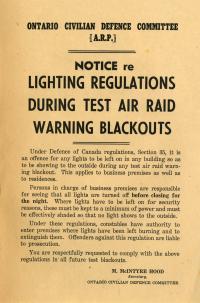
Enforcing the blackout
Although the danger of an air raid on Canada seemed slight, the Defence of Canada Regulations gave the authorities special powers to enforce a blackout during air raid drills.
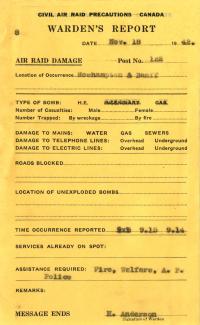
Air raid on Toronto !
Filled out as part of a 1942 air raid drill, these reports revealed that imaginary bombs had been dropped at Castlewood and Roselawn, Glengrove and Duplex, and Roehampton and Banff - and that 534 Roselawn Avenue was on fire.
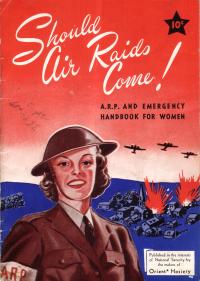
What to wear in an air raid
Reminding women that the enemy "has no consideration for the safety of civilians," this booklet (sponsored by Orient Beauti-Skin Hosiery) provided instruction on how to keep the family and home safe against enemy air attack - including advice on what to wear when dealing with bomb damage in the neighbourhood.
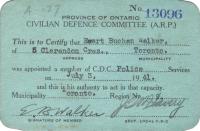
Civil defence in Toronto
Although Canada was in little danger of enemy air raids, there was a fully functional civil defence apparatus during the Second World War, with civilians deputized to perform various services in the event of an attack.
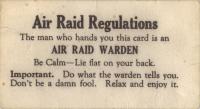
Do what the warden tells you
Wartime offered considerable scope for tasteless humour - as this card, brought home from Britain by a Canadian soldier after the Second World War, affirms.
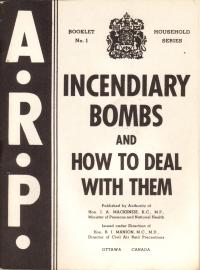
Safeguarding your home from fire bombs
Because the German Luftwaffe had used incendiary bombs with such devastating effect on Warsaw, Rotterdam, and London, Canadians were advised to be prepared for such attacks on their homes and businesses.