This short essay focuses on education within schools and universities during the Second World War in order to explore the relationship between war and learning. In elementary schools, high schools,…
Learning
Introductory Essay
Canada’s participation in the First World War has often been described as a coming-of-age – a trial by fire that transformed an immature colonial polity into an independent adult nation. Yet despite…
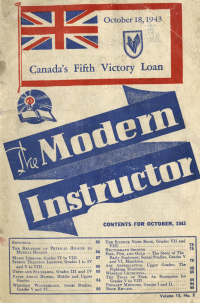
The Modern Instructor
The Modern Instructor was directed primarily at elementary school teachers. It includes lesson plans for each grade, with titles such as "The Relation of Physical Health to Mental Health" and "The Story of the Early Explorers", as well as numerous reminders to buy Victory Bonds.
Young Canada
According to its subtitle, Young Canada was "an illustrated annual for boys throughout the English-speaking world." In the tradition of this genre, it was full of bracing stories from all parts of the war, with the emphasis on the exotic and the unusual.
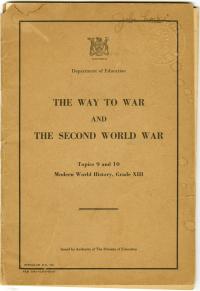
The Way to War and the Second World War
Ontario's Department of Education published this guide for teachers in high schools across the province on how to better instruct students about the key events that led to the start of the Second World War, and Canada's involvement in it. The book begins by identifying the world problem of collective security, and continues through the rise of Nazism in Germany, as well as the crumbling of collective security.
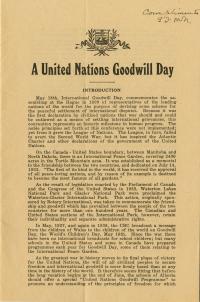
Alberta Looks Ahead to the Peace
This short play was to be performed by Alberta schoolchildren of all grades "to promote an understanding of the principles of freedom for which the United nations are fighting."
UN Goodwill Day.pdf
(47.06 MB)
Patriotic Drills
Patriotic drill books like this one were used in schools during the First World War, in order to instruct children in the meaning of the conflict. This one was printed by the Educational Publishing Company.
Patriotic Drills.pdf
(8.98 MB)
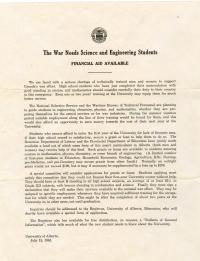
The War Needs Science and Engineering Students
During the Second World War, the University of Alberta published this letter calling on recent high school graduates to enter science or engineering programs in order to help the Canadian war effort. Financial aid was offered for those candidates, men or women, who demonstrated financial need and academic excellence.
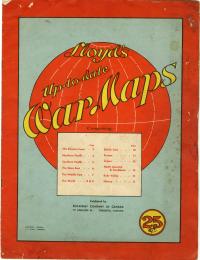
Lloyd's Up-to-date War Maps
Lloyd's printed these colour war maps for their customers. They feature all theatres of war, and have detailed points of interest for anyone wishing to better understand the geography of the Second World War.
Lloyd's Up-To-Date War Maps.pdf
(37.45 MB)
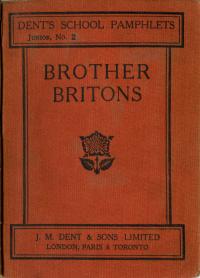
"Brothers-in-Arms"
Presented to a school in Steinbach, Manitoba, as part of the War Memorial Library of the Imperial Order Daughters of the Empire, this booklet told the story of Canadian, Australian, New Zealand, and South African soldiers during the First World War.
Brother Britons.pdf
(24.14 MB)
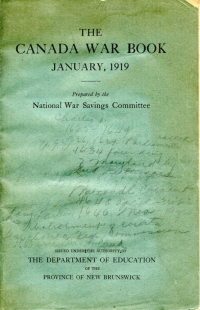
The Canada War Book
This book was issued to schools in New Brunswick as a textbook to instruct students about Canada's role in the war and their duty as Canadians to save money and materials needed for Canada's war effort. Although the armistice had been signed before this book was released, the war was technically not over until the Treaty of Versailles was signed in June of 1919.
The Canada War Book January 1919.pdf
(65.57 MB)
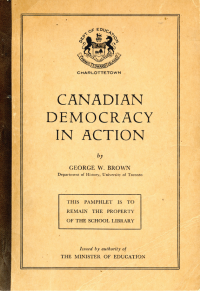
Canadian Democracy in Action
The Prince Edward Island Department of Education released this book to its schools to describe Canadian democracy and the operation of the government of Canada.
Canadian Democracy in Action 1945.pdf
(18.35 MB)